


Page 19 - Rare Earths and Rare Materials
P. 19
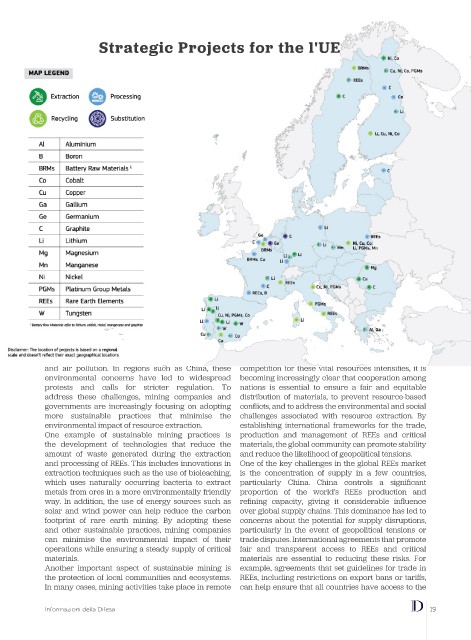
Strategic Projects for the l'UE                              or ecologically sensitive

                                                                                       areas where the impact
                                                                                       of resource extraction
            vehicle batteries, wind turbines and consumer  can  be particularly  damaging. In  particular,
            electronics, have relatively short life spans. However,  indigenous communities are often disproportionately
            the REEs and critical materials used in these products  affected by mining activities, as their water and land
            can often be recovered and reused. The REEs  resources  are  threatened  by  pollution  and  habitat
            recycling  process  involves  recovering  materials  destruction. To address these concerns, mining
            from discarded products, processing them to remove  companies must engage with local communities and
            impurities and returning them to the supply chain.  prioritise the protection of their rights and resources.
            This not  only reduces the  need for new  mining  This can include measures such as conducting
            projects, but also minimises the environmental impact  environmental impact assessments, implementing
            of resource extraction. By promoting the recycling of  water conservation techniques and restoring mined
            REEs from end-of-life products, countries can reduce  areas to restore ecosystems after mining has ceased.
            their dependence on primary imports and create a  Ultimately, recycling and sustainable mining practices
            more sustainable, circular economy.               are essential to ensure a stable and equitable supply of
            The European Union has taken a leading role in  REEs and critical materials in the future. By investing
            promoting the recycling of REEs and critical materials.  in technologies that enable the recovery and reuse of
            In 2020, it launched its Circular Economy Action Plan,  these materials from end-of-life products, countries
            which includes initiatives to increase the recycling of  can reduce their dependence on new mining projects
            REEs from  discarded electronic equipment,  electric  and minimise the environmental impact of resource
            vehicle batteries and renewable energy systems.  extraction. At the same time, by adopting more
            Japan has also been at the forefront of recycling  sustainable mining practices and protecting local
            efforts, investing in technologies to recover REEs  communities and ecosystems, countries can ensure
            from e-waste and other end-of-life products. These  that REEs and critical materials are extracted in a
            initiatives demonstrate the potential for recycling  responsible and ethical manner. These strategies are
            to play a key role in the future supply of REEs and  critical not only to ensuring a stable supply of REEs,
            critical materials.                               but also to protecting the environment and promoting
            Sustainable mining practices are another important  a more sustainable global economy.
            aspect of ensuring the long-term supply of REEs
            and critical materials. Traditional mining methods  Third,  international agreements and diplomacy
            often  have  significant  environmental  impacts,  play a critical role in mitigating the risks of future
            including habitat destruction, water contamination  conflicts over REEs and critical materials. As global
            and air pollution. In regions such as China, these  competition for these vital resources intensifies, it is
            environmental concerns have led to widespread  becoming increasingly clear that cooperation among
            protests and calls for stricter regulation. To  nations is essential to ensure a fair and equitable
            address  these challenges,  mining  companies  and  distribution  of materials,  to  prevent resource-based
            governments are increasingly focusing on adopting  conflicts, and to address the environmental and social
            more  sustainable  practices that  minimise  the  challenges associated with resource extraction. By
            environmental impact of resource extraction.      establishing international frameworks for the trade,
            One  example  of  sustainable  mining  practices  is  production and management of REEs and critical
            the development of technologies that reduce the  materials, the global community can promote stability
            amount of waste generated during the extraction  and reduce the likelihood of geopolitical tensions.
            and processing of REEs. This includes innovations in  One of the key challenges in the global REEs market
            extraction techniques such as the use of bioleaching,  is the concentration of supply in a few countries,
            which uses naturally occurring bacteria to extract  particularly  China.  China controls  a significant
            metals from ores in a more environmentally friendly  proportion of the world’s REEs production and
            way. In addition, the use of energy sources such as  refining capacity, giving it considerable influence
            solar and wind power can help reduce the carbon  over global supply chains. This dominance has led to
            footprint of rare earth mining. By adopting these  concerns about the potential for supply disruptions,
            and other sustainable practices, mining companies  particularly in the event of geopolitical tensions or
            can  minimise  the  environmental  impact  of  their  trade disputes. International agreements that promote
            operations while ensuring a steady supply of critical  fair and transparent access to REEs and critical
            materials.                                        materials are essential to reducing these risks. For
            Another important aspect of sustainable mining is  example, agreements that set guidelines for trade in
            the protection of local communities and ecosystems.  REEs, including restrictions on export bans or tariffs,
            In many cases, mining activities take place in remote  can help ensure that all countries have access to the


            Informazioni della Difesa                                                                         19

